How To Price Your Horse Farm

How To Price Your Horse Farm

This entry is part 1 of 3 in the series Equestrian Property Listing Tips and Tricks

Pricing a horse farm can be a daunting task. Between current market conditions and the price the seller wants for the property, there are many aspects to getting the right price.

Here are 5 useful tips to help you get to the right price for your equestrian property.


Making Comparisons

The simplest place to start is by comparing your property to similar properties that have sold, and ones that are currently for sale.

In Ontario, there aren’t a ton of horse farms to compare to. However, looking at similarities and making adjustments for any differences between properties will give you an idea of what your property might be worth.

Naturally, you’ll want to find properties that have similar locations, features and benefits to yours.

Horse properties generally take a while longer to sell than say country homes. So, we feel that looking at comparable properties that have sold between 12-18 months ago are still good comparables to look back on.

Paying close attention to past and current market conditions is extremely important.


Hiring a Professional

You could look into private appraisal companies that specialize in farm appraisals to assist with pricing your property. They generally come in on the lower end of what you might want, but it can be a good place to start.

Alternatively, you can do the right thing and hire an equestrian real estate agent. 🙂

Beyond making detailed and accurate comparisons to other equestrian properties, the right agent is going to understand the intricacies of pricing your horse farm.

We consider the value of the lifestyle that the property offers, what current and future opportunities it presents to buyers and the income it generates (if any). 

An equestrian realtor understands the emotional aspects of buying and selling such a property. They will be able to help you navigate through this in the pricing process much more intricately than someone with no or little horse experience.


Pricing Your Location

If we’ve said it once, we’ve said it a million times. The location of a property is extremely important.

Sure, with equestrian properties you aren’t going to have the usual “bad neighborhood” concerns, but location will still have a big impact on price.

What do we know? We all know that the closer you are to Toronto the higher the real estate prices are going to be. If you had the same equestrian facility in the Niagara Region as you did in York region – we can bet that the one in York will have a higher price.

Proximity is important as well. How close are you to horse shows, vets, farriers, other barns, to civilization. These factors and many more play a huge role in buyer and boarder demand.

It all depends on what the buyer is looking for and how your property fits into these needs.

That is to say, if someone is looking to run a show jumping training barn out of the facility – they’ll likely want to be located within a 1-hour radius of Palgrave and Angelstone. On the other hand, if someone is looking for seclusion and a place to keep a couple of retired horses, proximity to civilization isn’t as important.

If you haven’t read it, our equestrian real estate guide is an excellent tool for comparing properties and prices across many regions in Ontario. Get it here.


Price and Property Type

Naturally, the type of horse farm you are selling is going to play a role in how you price the property.

A large boarding and training facility is going to be priced differently from a standardbred racing stable and even more so from a small hobby farm.

With an income producing property, numbers will play a huge role in price.

Aside from valuing the facility itself and the future opportunity it may offer a buyer, you’ll need to take into account how much money the facility brings in on a monthly basis and price accordingly.

On the other side of the spectrum, a small hobby farm most likely won’t have the same facilities as a working barn show will. And so the land and existing residence may play the primary role in valuing the overall property instead.


Adding Value to Get The Price You Want

If your horse farm already has something unique to it that would add value to a buyer and their horses, then this is something that will need to be accounted for in price.

It could be anything from the classic wood railed fencing, a conditioning track, an over-sized indoor area, a forested / private lot, miles of hacking and so on.

If you don’t think you have a stand-out feature then think about how you can add value to your horse farm to warrant the price you want to ask buyers to pay.

Little things go a long way.

Ask yourself the following: could your property (home and or barn) use some paint, do the fences need repairing, does the driveway look in bad shape, could you prim up the front yard a little with some mulch and flowers?  Even updating items like light fixtures, door locks and faucets can improve the look of a property.

Another strategy is to think about what your property could be used for in the future.

Take this scenario as an example – you have a lovely property, a little barn, some paddocks, a home on the property but no indoor arena. If it were me, I would check in with the local municipality for permission on the possibility of building an indoor arena. Obtaining this permission could add value to potential buyers. It expands your buyer pool to those buyers who need an indoor arena as well. Sure, you may not fetch the same price for your property as though it had an indoor arena, but offering up this information can be a great selling feature.

Read onto the second series for tips on getting your property ready for sale.
Getting Your Horse Farm Ready For Sale

Getting Your Horse Farm Ready For Sale

This entry is part 2 of 3 in the series Equestrian Property Listing Tips and Tricks

Getting your horse property ready for sale might be the most important part of listing an equestrian property.

First impressions are made in an instant.

A good first impression helps a buyer see potential in a less than perfect property. But a bad first impression will cause a buyer to see any imperfections only as problems.

Cleaning Up The Barn and Residence

Start By Organizing and Decluttering.
There’s a reason every ‘tips for getting your home ready for sale’ real estate blog will mention decluttering your property.  Organizing, cleaning and decluttering your home is the easiest way to put your property’s best foot forward.

It also allows buyers to envision themselves living in the home and imagine their horses enjoying the barn. 

If you look at a mess on your property and think, “Ahh it’s not so bad, and besides, it’s a farm…” then the mess is probably going to look 10 times worse to a buyer and their agent.

Look, I get it. Barns are dusty and can be tough to keep clean.

Barn life isn’t the same as it is shown in magazines or on the ‘Beautiful Horse Barns’ Instagram page – with white walls, pristine lawns and stalls that look like they’ve never been lived in.

But if you want your property to look its best, it doesn’t hurt to use these fanciful images as inspiration for getting your barn ready for sale.

For instance, I often see perfectly folded blankets on stall doors in these fancy barn images.  I don’t know if that’s how the blankets look every day but they sure do for the photo-shoot!

Here is a 26 second video form SmartPaq on how to neatly fold blankets. It takes no time at all to have the blankets neatly folded for your listings photos.

The Little Details
I like to pay attention to the small details as well. By this I mean details we may not notice instantly but subconsciously we appreciate them.

Sure a buyer may not instantly appreciate that you took the time to dust off the rosettes hanging on stalls or scrub the grout between the tiles in the bathroom, but they seem to notice when you don’t.

It’s like training a horse – if you don’t pay attention to the small details, the bigger picture doesn’t come together.

Here is what we recommend:
The following is a short list of what we recommend to clients for their property photo-shoot. Ideally, these items would also be taken care of, when possible, before showings.

  • Neatly Fold blankets
  • Sweep Floors
  • Remove any Cobwebs from the stalls and barn
  • Power Wash Stalls (for photos only)
  • Clean Windows
  • Organize and clean the viewing lounge
  • Harrow arenas
  • Fix, Repair and Paint fences where needed
  • Organize bits and bobs that stay out for daily use (from cleaning supplies in wash stalls to mucking out equipment)
  • Wash and Scrub water and feed buckets (this should be done regularly anyway)
  • Empty muck out bins / wheel-barrows

Any residence(s) on the property should be properly cleaned and decluttered as well. Articles on this have been done hundreds of times, so I will spare you from more reading here. If you want home decluttering tips, this is a great article to get you started.

Landscaping

This goes hand in hand with taking care of the small details to give the buyer a great impression of your home and barn.

No need to go crazy here. I know landscaping can be expensive and you never really recuperate your costs for landscaping on the sale of your property.

But I do recommend taking care of the following for your property photo-shoot and before showings (if necessary and when possible):

  • Mow the lawn
  • If you have very weed-y paddocks, bush-hog and mow them. They always look better without overgrown weeds in them and this is probably better for the horses too.
  • Flowers or potted plants at the entrance seem to do wonders for first impressions.
  • If you have a gravel driveway, I know there are weeds growing in there. They should be removed.
  • If there are weeds growing in the coner of your outdoor sand rings, they gotta go too.
  • If your driveway is in rough shape (e.g. with potholes or perhaps could use spots of added gravel) do your best to repair it.

Take Care of Your Investment

When you buy a property, it is extremely important to take care of it for the future.  A run-down property is not going to fetch top value. 

A buyer can justify spending money on updating and improving a property if it has been taken care of.  But a property with broken fences and a leaking roof is unappealing and will more than likely be avoided by buyers.

Equestrian property buyers will wait for the right one to come along and we don’t care what kind of “potential” your property may have.  With horses always being the top priority, a barn in rough shape is hard to overlook.

Repairing roofs, fences, correctly managing grazing fields and making any necessary updates and repairs throughout the years will go a long way with maintaining a high value for your property in the future.

Taking care of your investment shows pride in ownership. A buyer can feel comfortable about paying a higher price for a property that has been well looked after by its current owners.


Make Sure The Major Systems are in Order

Many equestrian properties are located in a rural setting. This means water supply and sewage systems are likely coming from well and or septic systems.

These are costly to repair so the best thing you can do is ensure the correct use of them while you own the property and follow through with any maintenance and upkeep they require.

Wiring updates are crucial for horse farms, especially when it comes to the barn. Outdated wiring can be a serious hazard if not looked after.

Photo Shoot and Advertising

Each horse property has a story to tell – you need to tell it through your advertising.

Through photos and videos an equestrian property listing must show a lifestyle. You are selling a childhood dream after all.

You need professional lifestyle photos and videos that showcase your property in the best possible way. This, of course, is where you start to attract buyers.

Now, remember, if you present a beautiful property online and in magazine advertising, you need to present a beautiful property in person as well.

My days do not go well when my buyer is excited to view a property they loved online only for them to be disappointed by the property when they see it in person.

Our third and final article in this series goes into more detail on marketing the equestrian real estate lifestyle.

Selling The Equestrian Lifestyle

Selling The Equestrian Lifestyle

This entry is part 3 of 3 in the series Equestrian Property Listing Tips and Tricks


Marketing your equestrian property relies quite significantly on selling the equestrian lifestyle.  It isn’t selling the features of the property but rather the feeling that living on such a property could bring.

The First Impression

We discussed this point at length in our second series of equestrian property listing tips and tricks, so we’ll just skim the surface here.

It is essential to set your property up to give buyers a great first impression. This begins with the listing.

Immaculate photos, videos and advertising are a must. A well-maintained, clean and organized property will go a long way with creating value in a buyer’s mind.

Once you have a showing booked, you want buyers to feel excitement as they drive down the road to your property – this is the first time they will truly picture themselves becoming the owner of your equestrian property.

Highlight the Benefits and Opportunities

Sure, people need to know how many bedrooms and bathrooms the home has, and how many stalls the barn has. But listing the features of a property is not enough.

Think about what potential buyers would enjoy most about your barn and home. You need to highlight what types of “rewards” a buyer may receive from living in the home and from using the horse facilities.

Ask yourself:

Does the house offer views of the paddocks or barn from windows in the home?
Do you have a deck in the yard that the owners could enjoy on nights in with friends and family?
Is the home you are selling relaxing and inviting – something every rider will enjoy coming home to after long days (and nights!) at the horse shows?

What specific benefits does your facility have over others – Are there miles of hacking, heated grooming stalls, a walker, a large outdoor arena or a perhaps a conditioning track? 

Think about the market or discipline that you are trying to reach and make sure to highlight the benefits to those specific buyers.


Unique Marketing Features

What does your property have that other equestrian properties on the market might not have?

I know in Ontario we aren’t flooded with identical equestrian properties but if there are enough similarities in price and size on even one other property – highlighting a uniqueness can help the buyer see more value in your property over the other one. Make sense?

From extraordinary views of the escarpment to a second residence on the property – showcasing uniqueness can go a long way with a potential buyer.

It will help them picture themselves living their dream life on your property.


Advertising and The Listing

This is where you really get the buyer fantasying about their future life on your property.  To do this, you need to display your property at its very best.

For photos and videos, the property needs to be meticulous.  

If you have boarders, take pictures at first light before anyone gets to the barn. Make sure the barn is spotless, blankets are folded, stalls are clean and all clutter has been organized or cleaned away.

Videos are best for showing off what the lifestyle is about – if your barn has a story behind it, tell it.

Show buyers some of the benefits of your facility – if you have an eventing barn with a cross-country course, show your best horse and rider tackling some jumps. Show some of the workings around the barn – hay bailing at dawn, happy horses being led to turn out and so on.

Drone footage should also be mandatory for large equestrian properties too. There is no excuse for not having aerial shots of your facility these days either. It gives buyers a great overall perspective of the property.


Keep the Property Well Maintained & Clean

I’ve said this before but for many people buying a horse property has been a dream of theirs since childhood.

Your property doesn’t need to be the fanciest or most modern for it to show well. 

Presenting a well-maintained and clean property presents a lifestyle that shows care and happiness. This goes a long way with buyers looking for the commitment of owning horse property.


Patience Is Key

Equestrian properties typically stay longer on the market than most other property types.

Horse farms are a niche product. Generally set in price ranges at the higher end of the real estate market, they take a special buyer who is willing to not only spend that kind of money but put in the time and commitment it takes to own this type of property.

Investing in Rural Real Estate

Investing in Rural Real Estate

The battle between land development and attempts to control urban sprawl has many caveats.

We can appreciate both sides of the argument but believe strongly in protecting agricultural land and green spaces from development.  

With many investor eyes on Canadian Real Estate and hundreds-of-thousands of people moving to the GTA every year, we thought it important to write an article that focuses on investing in rural real estate in a way that preserves agricultural land and green spaces.


Notable Statistics and Particulars

Large Acreages and Farms:

  • Farmland Prices as a whole, rose 8.4% in Canada in 2017. In South Western Ontario specifically – where the vast majority of farms are located in Ontario – there was an increase of 9.7%. Bringing the cost per acre up to $12,730!
  • Interest Rates were increased twice in 2018. Over the year, it will be interesting to see how much of an impact this has had on farmers’ abilities to expand.
  • NAFTA Trade Agreements could adversely impact the economic viability of supply-managed farms.   In Canada, a lot of farmers operate under a supply management system.  In short, this system allows farmers to act collectively to negotiate price and adjust production to meet consumer demand. Since these farmers make up a large percentage of land purchasers, it is possible there will be an impact on land values with changes to this agreement.

Small Acreages / Country Homes:

  • Average Sale Price of .5 – 1.99 acres in Southern Ontario is ~ $600,000.
  • Average Sale Price of 5 – 9.99 acres in Southern Ontario is ~ $800,000.
  • These prices have almost doubled in the last 10 years.

What Are Your Options?

Now that you have a bit of an idea of where values are … you might be asking why and how the average person could invest in farmland or rural real estate in general.

Like Gold, farmland is looked at as a hedge against inflation.

As food prices rise, so should the value of the land to produce the food.  Beyond the hedge however, it also offers the possibility of income for investors.


Option 1: Purchasing Farmland Directly

Owning farmland with no improvements (i.e. buildings or infrastructure) is going to be your simplest course of actions. Here you can avoid cash out of pocket for maintenance and repairs on buildings.

Essentially this is a buy, hold and rent scenario. Something you may be familiar with if you have invested in regular residential real estate.

On the other end of the spectrum, you may want to pull the trigger and become a full-time farmer. There are too many types to mention in one article. But, whichever you choose – you’ll need to look at it as a business like any other. One with specific taxation rules as well as advantages that can be useful if implemented properly. 

Having a good accountant versed in farming and agriculture will be a must!


Option 2: Farm Fund Investing

As global food demand and personal incomes increase around the world, the demand for high-quality agricultural products has been projected to grow. 

In 2016, the agriculture and agri-food system generated $111.9 billion of gross domestic product, accounting for 6.7% of Canada’s total GDP.1  

Buying a farm may not be for everyone, but enjoying a piece of this revenue might be.

For those who like the idea of investing in farmland but don’t want to directly purchase the real property – farmland funds could be the way to go.s

This is a popular option with Investors that want to park capital into something tangible.   Instead of going it alone, a group of investors pool their money together to buy the asset (farmland) and then, put simply, rent the land out to farmers.

Option 3: The Part-Time / Rural Resident

Generally, a part-time farmer often purchases a farm with a house to live in that either comes with other existing infrastructure – such as barns or sheds – or plans to build what is needed. 

The aim is to have a small farm business for generating extra income while also living on the property. This option is typically for investors who have a passion for farming.

A part time farmer might use a small section of the property to grow fruits or vegetables that they then sell at a local farmers market. Others might raise a few beef cattle.

To further income, some choose to lease out the remaining acres to a farmer.

Unlike a full-time farmer, a part time farmer’s main source of taxable income will NOT be generated from farming. However, there are some interesting property and income tax advantages to being a part time farmer.

Again, a good accountant versed in this space is key!

From an investment standpoint, the same land value aspects mentioned earlier still apply.

Option 4: The Hobby Farm or Residential Country Home.

A hobby farm is a small-scale farm that someone would own for their own personal enjoyment (as would be a country home). Most likely it would be situated on some acreage, allowing the owners to use the land for planting their own vegetables, raising chickens or whatever their preference may be.

Appreciation would be your main investment focus for this options.

As the label “hobby” would imply, unfortunately, hobby farmers are not allowed to claim any farm expenses as income tax deductions.

That’s why it’s important to avoid having the Canada Revenue Agency classify you as such if you ever intend to make a full or part time living from your farm. One more time… ACCOUNTING!! 🙂

When it comes to buying an acreage you will want to have an idea of what your intentions are for the property and if the property will allow for it.  Zoning will be key here!

Do your research so you are not limited to gardening should you have bigger plans like keeping livestock on the property.

A Note on Financing

Financing Farm Land

Naturally, agricultural financing is different from residential financing.

Shopping around for different lenders that specialize in farms will be integral.

Farm Credit Canada (FCC) is a big lender. Although they may not have as competitive a rate as smaller lenders, they do offer useful auxiliary programs like financing farming equipment.

However, it is advisable to research your options with traditional big banks, smaller lenders and credit unions as well.

Financing The Hobby Farm or Country Home

Generally speaking, as long as you don’t plan to generate income from or farm the property, country properties and rural residences are financed in the same way as a home in the city

As a general rule of thumb, anything 10 acres and under (not intended for farming or income purposes) should qualify for residential lending.

If the hobby farm or country home you are interested in purchasing is on 15 acres, the bank may only approve the home + the ten acres, leaving you to come up with the amount for the remaining 5 acres.

Financing isn’t an exact science. Different lenders will look at different properties in different ways. So it important to shop around or have a good mortgage broker with knowledge of this type of financing.


We’ve only scratched the surface with this article. Hopefully we’ve expanded your ideas about the value of land and your options for investing in rural real estate.


  • Statistics provided by Realtors Association of Hamilton-Burlington and the Toronto Real Estate Board.
10 Of The Best Canadian Country Retreats

10 Of The Best Canadian Country Retreats

Perhaps you’re not quite ready to give up the hustle and bustle of city life for the serenity of the countryside, or perhaps you’ve moved to the country and forgotten why the lifestyle charmed you in the first place.

Get your taste of the country life and book a weekend retreat at one of these places, or get inspired by what you could do with your own county home.

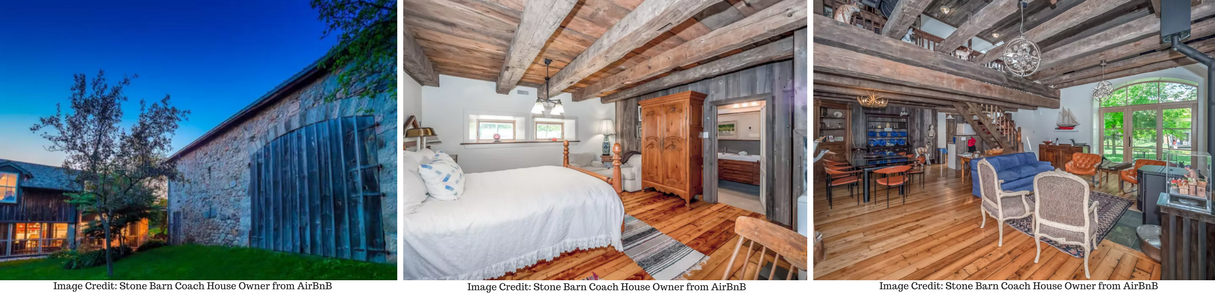
1. Stone Barn Coach House

Where history and country charm meet. What a gorgeous property! The old stone barn has been beautifully restored and transformed into a stunning Airbnb rental.  Get everything you need out of country living on this one.

$249 / night
Old Stone Barn
Guelph, Ontario


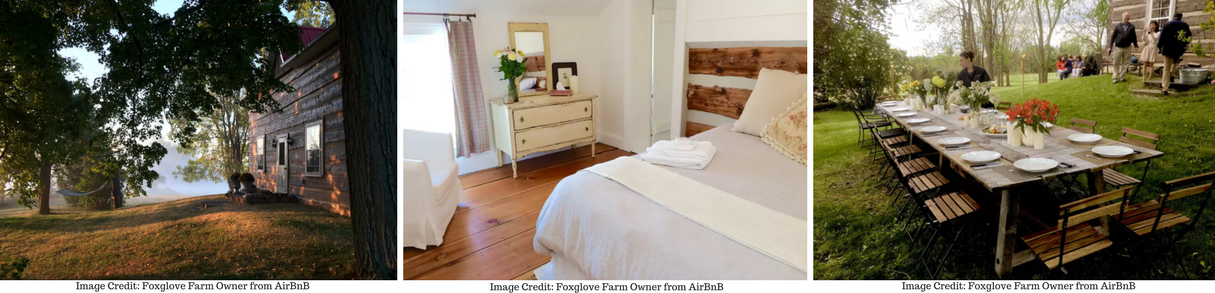
2. Foxglove Farm

If you are looking for a taste of the country life, this is a great place to start. A chance to live in – even for a few nights – a beautifully rustic vintage log farmhouse. Nestled among rolling hills and sprawling fields, here you’ll be able to experience the freedom of country living.
$495 / night
Foxglove Farm
Adjala-Tosorontio, Ontario


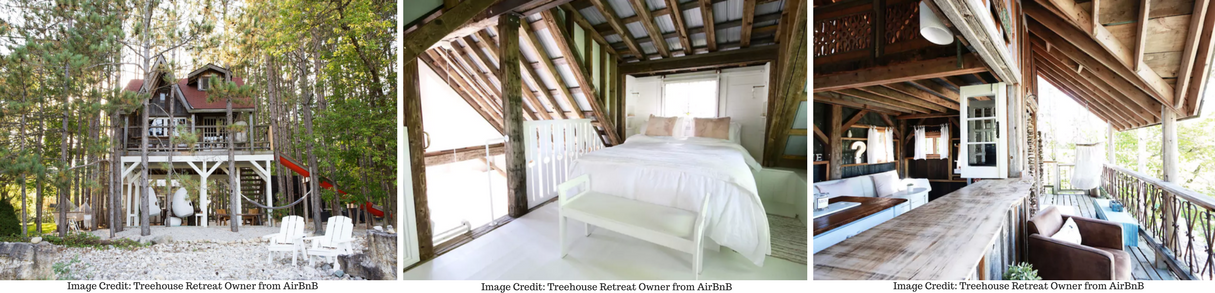
3. The Treehouse Retreat

If you were enticed by the look of the exterior of the home, wait until you sift through the photos and check out the inside. A truly serene vacation rental for a romantic getaway, friend’s weekend or an ideal sanctuary to start writing that book or blog you’ve been thinking about.
$785 / night
Treehouse Retreat
Durham, Ontario


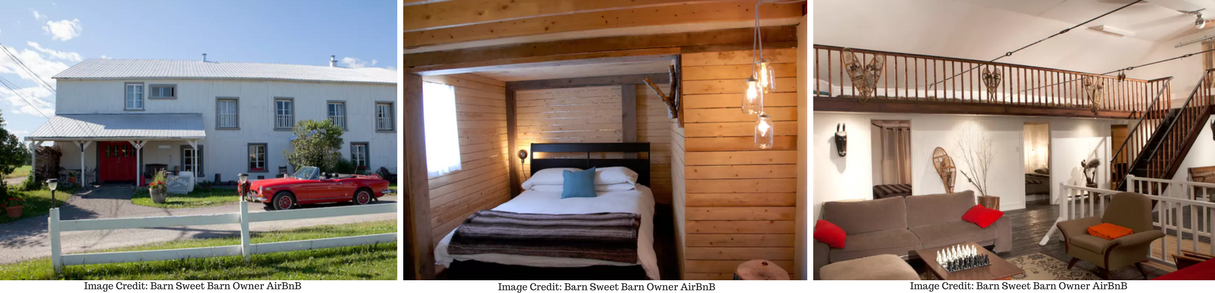
4. Barn Sweet Barn

An old barn converted into a luxury Airbnb rental – how quintessentially country! With Confiturerie Tigidou, the jam factory located on the ground floor of this transformed barn, the rental has been aptly named. If you’re into country charm (and who isn’t?) you’ll adore this country treat!
$355 / night
Sweet Barn
Saint-Jean-de- Île-d’Orléans, Quebec


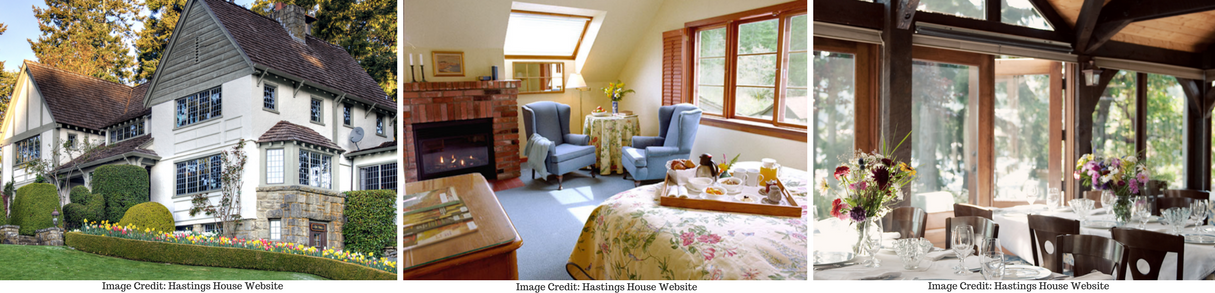
5. Hastings House

A country house hotel on a spectacular country estate. Inspired with the allure of the old English countryside, this now country style resort has breathtaking landscapes and water views. All rooms and suites have been designed and styled with true country charm in mind.
$405 – $900 / room (depending on room and time of year)
Hastings House
Salt Spring Island, British Columbia


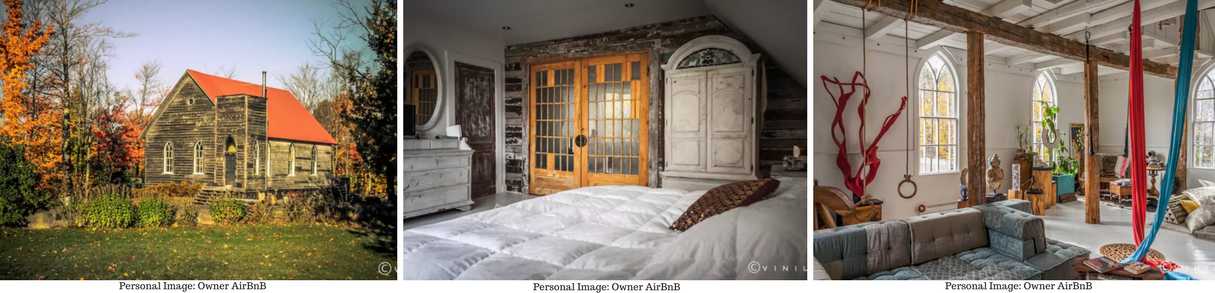
6. Country Church Turned Country Home

I did tell you this list was unique! Take advantage of the calm surroundings and peacefully valleys by staying in this eclectically styled country church turned country home. With mature trees and winding roads, you’ll have an exclusive county experience renting this home
$295 / night
Country Church House
West Bolton, Quebec


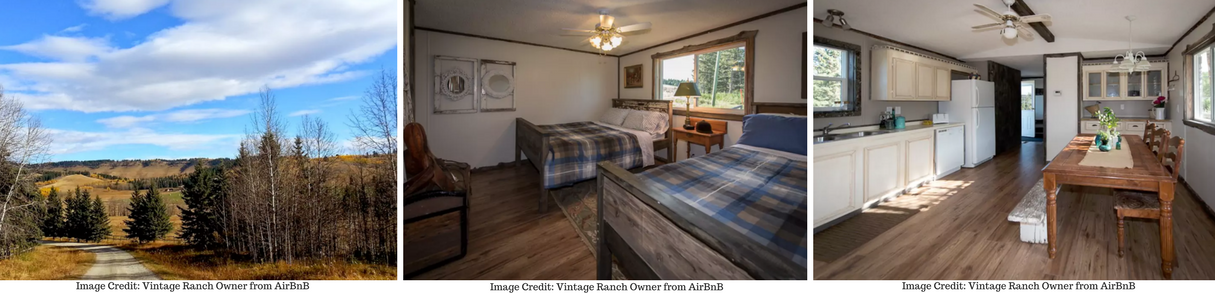
7. Vintage Ranch

In Alberta, ranches are really just glorified country homes with mountain-views, horses and space. Lots and lots of wide-open space.  This lovely guesthouse offers a blend of country-chic and classic cowboy living. If you’re vacationing in Alberta, be sure to check this one out.
$150 / night
Vintage Ranch
Rocky View County, Alberta


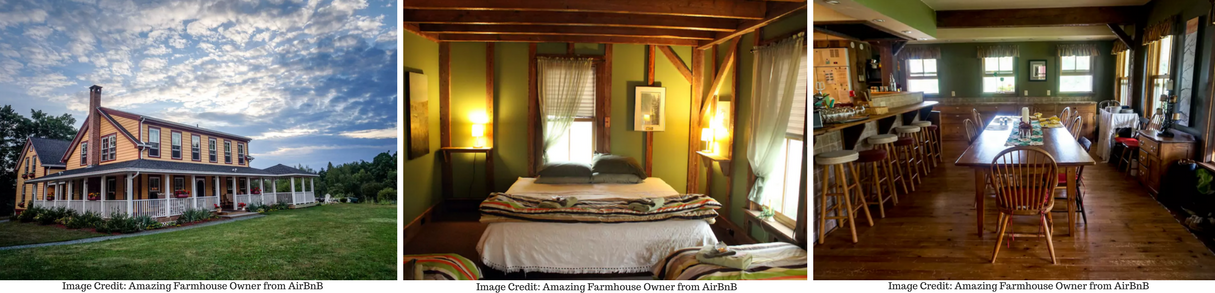
8. Grand FarmHouse

This ideal and true farmhouse seems like the quintessential country retreat. There’s space enough for you, your friends and your family to relax, unwind and spend some quality time together. It is easy to imagine one’s self hear, breathing in the fresh morning air and taking in the serenity of Nova Scotia’s countryside.
$920 / night
Farmhouse
Newport, Nova Scotia

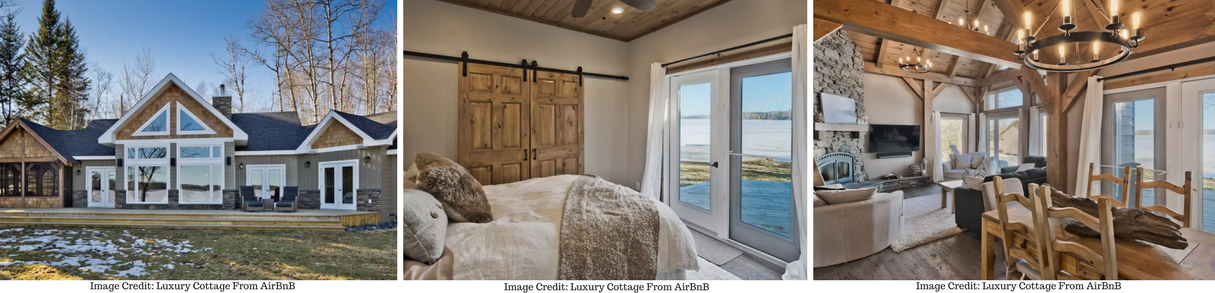
9. Rustic Cottage

Ok, yes, more cottage than country home, but we wanted to spread our country love to Manitoba and look at how stunning this home is! Wood barn beams, waterfront views, rustic-chic furnishings and privacy – sounds pretty country-esque to us. This Airbnb rental ticks all the boxes for a relaxing, fresh air filled vacation retreat.
$299 / night
Rustic Cottage
Whiteshell, Manitoba


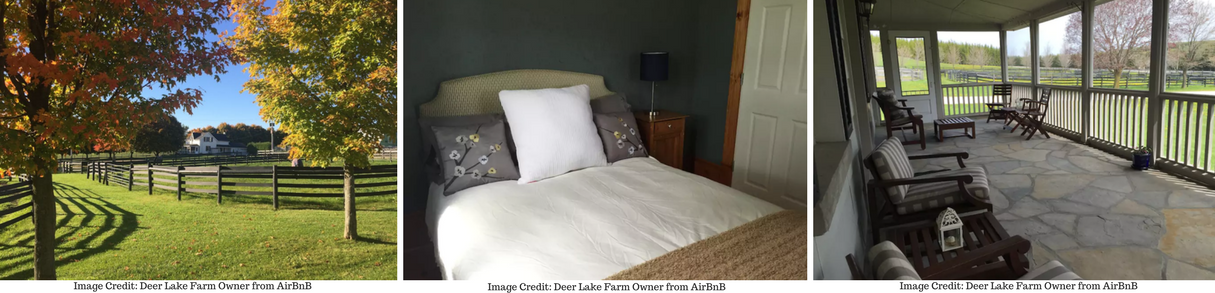
10. Deer Lake Farm

Ahhhh… (That’s a peaceful sigh just in case it wasn’t clear. 🙂 Here’s your chance to experience country extravagance. This gorgeous farm estate has it’s own lake and private equestrian facility. The ideal way to wake up, breath in the fresh air and experience the wonderful lifestyle of country living

$259 / night
Deer Lake Farm
Singhampton, Ontario

That’s it for now folks! We hope we’ve inspired you in some way. If you’ve seen a country retreat or vacation rental that should have made our list let us know and we’ll update this list just for you. 🙂